




Director Wu Tong, Director Li Zhihui and Professor Tao Yong’s Collaborative Team: First Report of Purtscher-like Retinopathy After CAR-T Bridging to Transplantation
2026-2-13With the expanding application of CAR-T cell therapy in relapsed/refractory hematologic malignancies, an increasing number of patients achieve deep remission and proceed to hematopoietic stem cell transplantation (HSCT). Meanwhile, the cumulative use of multi-line immunotherapies has led to more complex post-transplant complications. Early recognition of atypical manifestations and timely intervention have therefore become critical issues in clinical practice.
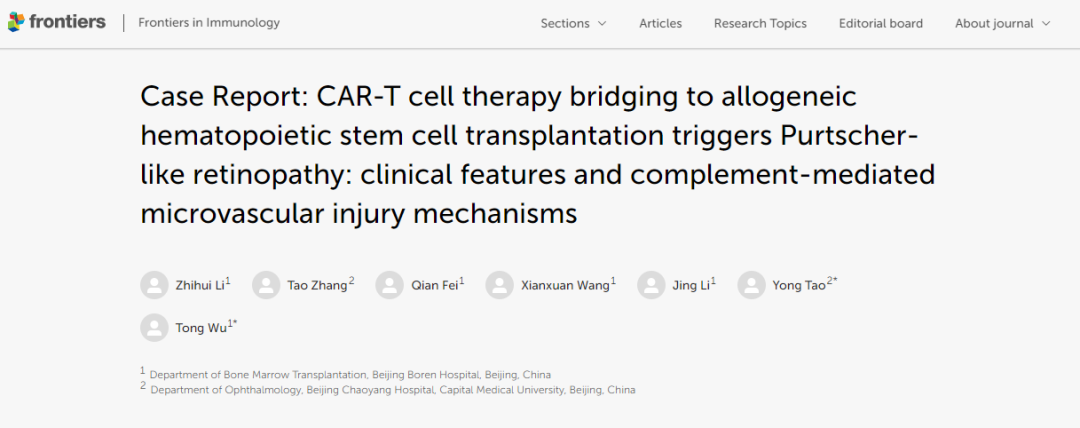
Recently, a collaborative team led by Director Wu Tong of GoBroad Healthcare Group and Professor Tao Yong from Beijing Chaoyang Hospital, Capital Medical University (co-corresponding authors), with Director Li Zhihui of GoBroad Healthcare Group as first author, published a case report in Frontiers in Immunology. The study is the first to systematically describe a rare case of Purtscher-like retinopathy (PLR) occurring after CAR-T therapy bridging to allogeneic hematopoietic stem cell transplantation (allo-HSCT), and to explore its potential mechanistic association with transplant-associated thrombotic microangiopathy (TA-TMA).
Director Li Zhihui noted that some post-treatment complications do not initially present with typical hematologic abnormalities, but instead manifest as localized and non-specific symptoms, increasing the difficulty of early recognition. Based on this observation, the team conducted a comprehensive analysis of this rare ocular event following CAR-T and transplantation, aiming to highlight the systemic implications behind atypical symptoms in the context of complex immunotherapy.
Case Overview
From multi-line immunotherapy to transplantation: a complex treatment trajectory
The study reports a pediatric patient with relapsed B-cell acute lymphoblastic leukemia (B-ALL). After initial standard therapy and remission, the patient experienced first hematologic relapse approximately 2.5 years later. CD19 CAR-T therapy was administered and induced remission. To consolidate disease control and reduce the risk of antigen escape, sequential CD22 CAR-T therapy was given.
In 2024, the disease progressed again with relapse and extramedullary infiltration. Treatment strategy shifted to antibody-based immunotherapy to achieve re-remission, including anti-CD22 antibody-drug conjugate (inotuzumab ozogamicin) combined with immunomodulatory therapy (such as belimumab). After achieving a transplant window, the patient underwent allo-HSCT.
Recognition and management of sudden visual changes: imaging features and treatment response
Approximately 160 days after transplantation, the patient developed sudden painless vision loss with metamorphopsia and no history of trauma. Comprehensive ophthalmologic evaluation, including fundus photography, optical coherence tomography (OCT), and fluorescein angiography, confirmed the diagnosis of Purtscher-like retinopathy.
Intravitreal ranibizumab (0.5 mg) was administered to the left eye once monthly. Six days after the first injection, visual acuity in the left eye improved significantly, accompanied by reduction of optic disc edema and retinal hemorrhage.
Cytometric bead array analysis of aqueous humor revealed significantly elevated levels of basic fibroblast growth factor (bFGF) and vascular cell adhesion molecule-1 (VCAM-1), suggesting disruption of the blood-retinal barrier.
During this period, the right eye experienced rapid visual decline with increased retinal hemorrhage, cotton-wool spots, and worsening optic disc edema. Intravitreal ranibizumab (0.5 mg) was then administered to the right eye. Eight days after the first injection, although right-eye visual acuity did not significantly improve, fundus examination of both eyes showed marked reduction in retinal hemorrhage, cotton-wool spots, and optic disc edema, indicating a positive effect of anti-VEGF therapy in controlling retinal microvascular lesions.
From ocular findings to systemic evaluation: identification and management of TA-TMA
While evaluating and treating the ocular condition, the team conducted systemic assessments. On post-transplant day 179, lymphocyte subset analysis showed a CD4/CD8 ratio of 0.22, B cells 5.05%, and NK cells 21.68%, indicating impaired immune reconstitution.
By day 194, the patient developed severe thrombocytopenia (nadir 40×10⁹/L), massive proteinuria (24-hour urine protein 2400 mg), renal dysfunction (serum creatinine 133.9 μmol/L), complement activation (C5b-9 298 ng/mL), and polyserous effusions. After excluding graft-versus-host disease and calcineurin inhibitor toxicity, and noting increased schistocytes (0.8%) in peripheral blood, a diagnosis of TA-TMA was established.
The patient received defibrotide and eculizumab, along with supportive care including diuretics, antihypertensive therapy, and management of capillary leak. The overall condition gradually stabilized.
Conclusion and Perspectives
Director Li Zhihui emphasized that this is the first systematic report of Purtscher-like retinopathy occurring after CAR-T bridging to allo-HSCT in a pediatric patient with relapsed B-ALL. Notably, ocular manifestations preceded some systemic changes, providing new insight into the development of post-transplant microvascular complications.
In the era of increasingly integrated immunotherapy and transplantation, clinicians should remain vigilant for sudden visual disturbances and other atypical symptoms. Combining imaging assessment with systemic evaluation may facilitate early identification of microangiopathy or complement-related abnormalities and enable timely intervention. Multidisciplinary collaboration and refined evaluation strategies may further optimize the recognition and management of post-transplant complications, ultimately improving treatment safety and prognosis.


